Development teams often spend significant time and money chasing new donors, and that chase is only getting harder.
According to Giving USA 2026 data, the number of individual donors continues to decline nationally. With their current donors, they may run wealth screenings to ask a focused question: Who has the capacity to give right now? Answering that question is a good next step, one that can build engagement and revenue.
But what if we asked a bigger question instead: Where should we invest today to grow relationships, and philanthropy, over time?
The same Giving USA data shows growth in giving overall, including a nearly 17% increase in bequests when adjusted for inflation—a sign that deferred giving, paired with strong annual and major giving from an organization’s most loyal supporters, remains a real opportunity. This shift moves us from chasing the next gift to building donor lifetime value. This is where opportunity lies for those willing to lead the shift.
Start with One Donor
A gift officer at a midsize university cultivated an alumnus whose giving spanned more than three decades, starting with modest $50 and $100 gifts. In 2012, he made his first deferred gift (a bequest of $600K), then increased his bequest by 50% six years later and doubled it eight years after that, as his annual giving climbed to $12,000–$20,000. No single blockbuster ask drove this—just steady visits, cards, and impact reports at an average of about twice a year.
Over decades, a modest annual donor became a philanthropic investor in his alma mater. That raises a key question for development leaders: Could your data help you identify more donors like him earlier in their philanthropic journey?
Three Data Points Worth Looking at Differently
Building donor lifetime value starts with seeing more possibility in the donors you already have. Three data points, considered together, can help development leaders identify relationships with the potential to grow and make thoughtful decisions about where to invest time and attention.
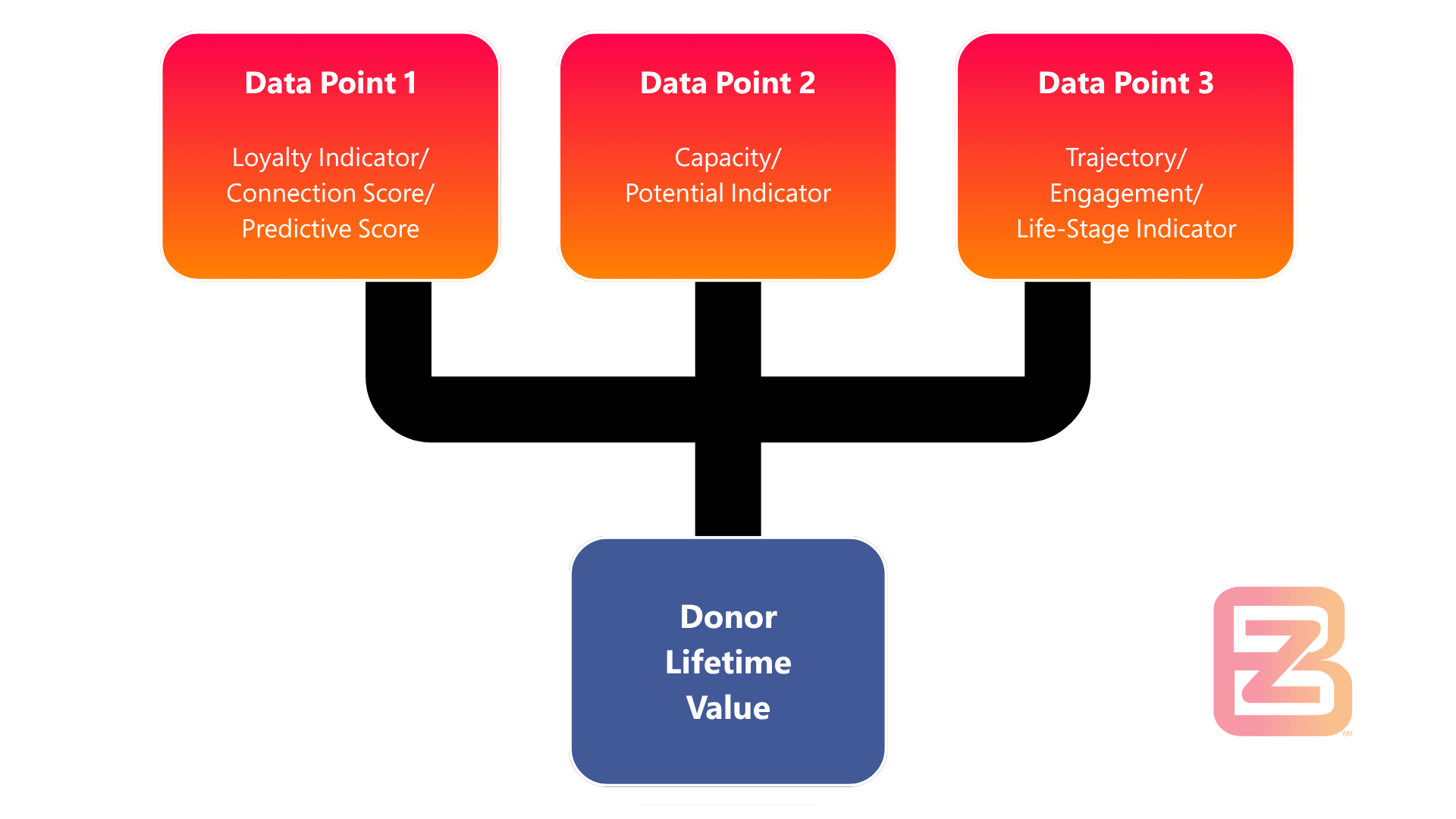
Data Point 1—Loyalty Indicator/Connection Score/Predictive Score
What the data tells us: Your organization’s CRM is the ultimate proprietary dataset: No external source can describe your unique donor relationships as well as your own data. Custom connection, engagement, propensity, predictive, or even basic RFM scoring can reveal the characteristics that distinguish your strongest prospects and help prioritize the pipeline by warmth and readiness.
Ideally, these tools should be dynamic updating alongside donor behavior so resources remain focused on where they can have the greatest impact.
Lifetime-value question: Which donors show sustained commitment, even at modest gift levels?
Donor example: Our university alumnus began with annual gifts of $50 and $100. His consistency over time was an early indicator of a relationship with room to grow.
Lesson: Loyalty can be an early signal of future donor value.
Data Point 2—Capacity/Potential Indicator
What the data tells us: External wealth and philanthropic data add another dimension by identifying where strong connection intersects with meaningful capacity. Because direct relationship management can substantially increase a prospect’s lifetime value, organizations should use both internal and external data to determine where those limited resources are most likely to produce results.
The best opportunities may initially look quite ordinary; data helps gift officers know where to apply the relational skills that turn potential into realized support. A loyal $250 donor with significant capacity, for example, may be someone worth getting to know more deeply. Capacity can help determine where additional relationship-building could create greater philanthropic opportunity over time.
Lifetime-value question: Where does demonstrated commitment intersect with greater capacity—and how might we help that relationship grow?
Donor example: Our alumnus’ annual giving eventually grew from $100 to $20,000 as his relationship with the university deepened.
Lesson: Capacity helps reveal what’s possible; relationship-building helps realize that potential.
Data Point 3—Trajectory/Engagement/Life-Stage Indicator
What the data tells us: Looking at donor behavior over time helps development leaders see how relationships are evolving. Dashboards and reporting can help steer the ship, not simply grade performance. Tracking prospects over time allows teams to recognize opportunities as they emerge—who is heating up or cooling down—and refine individual strategies, whether that’s deeper cultivation, time for a major gift conversation, or an invitation to consider planned giving. This must be integrated into everyday fundraising practice because lifetime value is a trajectory, not a transaction.
Lifetime-value question: Which donors are moving into a new stage of their philanthropic relationship—and where might that relationship go next?
Donor example: Annual donor → deferred gift → 50% bequest increase → growing annual gifts → doubled bequest. Looking across the full relationship reveals an expanding commitment to the institution.
Lesson: Donor trajectory helps us see, and cultivate, the potential of a relationship over time.
From Three Data Points to a Different Kind of Goal
This is where fundraising strategy and data science perspectives converge. Development leaders need to translate the intelligence they already have into relationship goals. After all, it’s not just about building more one-off predictive models or yet another prospect list. Instead of measuring success only by dollars raised, major gifts secured, or new donors added, consider goals that also ask:
- How many loyal donors will we identify for deeper engagement?
- How many high-capacity, long-term donors will receive meaningful personal cultivation?
- How many donors will move from transactional annual giving toward deeper philanthropic engagement?
- How many conversations will include long-term or legacy giving?
These goals don’t replace revenue targets. They are investments in the revenue—and mission impact—that may come over the next 10, 20, or 30 years.
Three Things Development Leaders Can Do Now
1. Find your overlooked loyalists
Work with your data team to identify a manageable segment of long-term donors who meet the three indicators discussed above. Don’t begin with thousands—start with 50 or 100 donors and ask: Who on this list deserves more attention than they are receiving today?
2. Build a relationship goal—not an ask goal.
For that group, create a 12-month engagement strategy. The objective isn’t to secure a larger gift from every donor this year, it’s to learn more about them, deepen the connection, and identify where the relationship could go next. Measure meaningful contacts, visits, expressions of interest, documented philanthropic motivations, and movement toward deeper engagement.
3. Measure movement over multiple years.
Don’t judge the strategy solely by year-one revenue. Track how these donors change over time—retention, annual giving, upgrades, major gifts, planned gift conversations, and commitments. This is where data science becomes especially powerful, helping leaders see whether their investment in relationships is actually increasing donor lifetime value.
See the $100 Donor Differently
If our client had evaluated their university alumnus only by his first $100 gift, they would have badly underestimated him. If they had evaluated him only by his first planned gift, they still would have misjudged the situation. Even after he increased his bequest by 50%, they wouldn’t have known that eight years later he would double it—or that his annual giving would eventually reach $12,000 to $20,000. That’s the problem with evaluating donors one transaction at a time. A capacity analysis can help identify possibility, but the real opportunity comes when development leaders combine that intelligence with patience, meaningful engagement, and a willingness to invest in relationships over time. The question isn’t simply who can give us more? It’s this: Which relationships have the potential to create significantly more impact over a lifetime—and what are we doing today to help those relationships grow?
Building donor lifetime value takes the right data, the right questions, and the right partner. Visit bwfzuri.com to learn more about our approach or reach out to BWF Zuri directly to talk about how we can help you uncover the loyal, high-capacity donors already in your database—and turn that intelligence into lasting philanthropic relationships.