Overview
Throughout 2025, as uncertainty loomed large over the nonprofit sector, BWF Zuri consultants’ guidance to client partners and advancement leaders was to focus on effective fundraising fundamentals and what they and their teams could control:
- Continue to take a disciplined, measured approach to principal and major gift fundraising.
- Focus on constituent engagement to build your donor pipeline and thoughtful donor retention and renewal strategies.
- Lead with your mission and impact, inviting donors to be part of creating change with you that will shape lives and uplift communities.
With the release of this year’s Giving USA report, data is available that offers insights into the impact of the uncertainty brought about by political and economic change as well as the continued efforts of fundraisers to connect donors to mission.
Data is telling us both how philanthropy was shaped in 2025 and how it may be further shaped in the future by the events and economics of 2026. It reinforces that nonprofit and fundraising leaders must continue to build on and refine their strategies through a focus on the fundamentals of effective fundraising.
Donor counts nationally are declining, but organizations are bucking that trend through thoughtful engagement. The total given by Americans to charity continues to grow, even as competition for donor dollars does too.
Investing in a fundraising program that creates genuine connection with donors, that uses data-driven initiatives and measures to drive progress, and that focuses on intentional donor journeys that spark joy within donors continue to be winning strategies.
2025’s Giving Data in the Context of 2026’s World
A year ago, 2024’s Giving USA Insights Report was being contextualized in the realities of 2025 with industry experts looking to predict the impact of new policies on giving. This year’s report and analysis are again a look at fundraising trends in a moment of transition that will likely reshape philanthropy in the near term.
Tax code changes passed as part of last summer’s One Big Beautiful Bill Act (OBBBA) took effect on January 1, 2026, meaning the impact of new non-itemizer deductions and changes to corporate and ultra-high-net-worth individuals’ tax incentives will not be seen until 2026’s insights are released in 2027.
The Giving USA report points to declining inflation in 2025, down to 2.6%, as a potential factor in the growth of overall giving. Economic volatility in the first half of 2026 and whether it dissipates may well shape giving in 2026.
Key Findings from Giving USA 2026
Total estimated charitable giving reached a new current-dollar high of $617.20 billion in 2025, surpassing $600 billion for the first time. This total is up from $592.50 billion in 2024—an increase of 5.7% in current dollars and 3.0% when adjusted for inflation.
Giving by Source
- All four sources of giving grew in current dollars and inflation adjusted dollars, an improvement over last year when all four sources grew in current dollars but only individuals and corporations saw real (inflation-adjusted) growth.
- Giving by individuals totaled $394.20 billion, growing 4.1% in current dollars and 1.4% when adjusted for inflation. Individuals remain the largest source of giving, accounting for 64% of total contributions, down 2% from the previous year.
- Foundation giving reached $117.15 billion, a 5.7% increase in current dollars and 3.0% when adjusted for inflation. Strong markets have fueled foundation giving, which has grown in current dollars each of the last 15 years.
- Bequest giving grew significantly to $62.19 billion, up from $45.84 billion in 2024. Growth is 19.7% in current dollars or 16.6% in inflation-adjusted dollars. This growth comes after bequest giving decreased in 2024. Bequests represented 10% of total giving in 2025.
- Corporate giving was flat year-over-year at $46.4 billion in 2025, which is only .5% above the previous year.
Giving to Subsectors
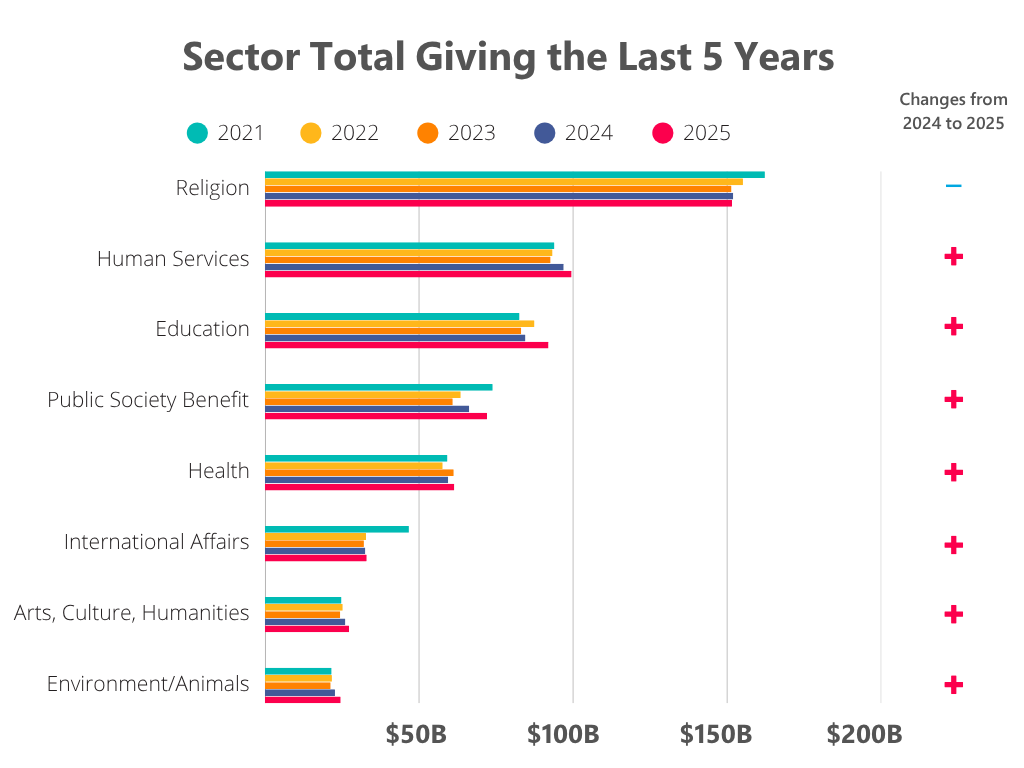
- Seven of nine subsectors saw real growth in giving.
- Five subsectors reached all-time highs even after adjusting for inflation:
- Education: $92.01 billion (+11.7% current, +8.9% real)
- Human Services: $99.50 billion (+5.3% current, +2.6% real)
- Health: $61.43 billion (+6.1% current, +3.3% real)
- Arts, Culture, and Humanities: $27.31 billion (+7.5% current, +4.7% real)
- Environment/Animals: $24.57 billon (+11.0% current, +8.2% real)
- Public society benefit organizations saw an 11.5% increase in current dollars and an 8.7% increase when adjusted for inflation, reaching $72.06 billion, driven in part by growth in donor-advised funds (DAFs).
- Giving to International Affairs grew by 4.1% in current dollars and 1.4% when adjusted for inflation to $33.02 billion.
- Five subsectors reached all-time highs even after adjusting for inflation:
- Giving to religion grew 2.4% in current dollars but was flat at -0.2% when adjusted for inflation. While it continues to represent the largest share of giving at 23%, its share of overall giving continues its decade-long decline.
- Gifts to foundations decreased to $79.05 billion, down 16.2% in current and 18.3% in inflation-adjusted dollars. The last five years have proven volatile for this subsector, which saw steep increases in 2021 and 2024 over previous years.
Key Trends Breakdown and Analysis
Giving Grew as Nonprofit and Philanthropic Realities Shifted
After two years of nominal growth, giving is back on a trajectory more in keeping with long-term historical trends. Whether this holds true through 2026 will depend on a number of factors within and outside the control of nonprofit and fundraising leaders. Focusing giving programs and fundraising staff on the right activities that engage the right donors will be central to bringing continued growth to reality in 2026.
At the same time, financial pressures on nonprofits will put added emphasis on the need to increase fundraising revenues and to find new income sources. Shifts within the sources of giving complicate this reality, with bequests presenting a strong opportunity for deferred revenue. Meanwhile, the growth of DAFs and limited growth in individual giving put added pressure on development teams to focus on major and principal-level gifts and alternative giving vehicles.
Individual Giving Growth Defies Expectations, Shrinking as a Share of Overall Giving
While individual giving grew in 2025, historical giving trends suggest that strong stock market growth should have resulted in more growth, but that growth was offset by record low consumer sentiment, a factor that plays more heavily into the decision-making of larger populations of donors. A myriad of other factors likely contributed to this reality, including:
- The continued national trend of declining donor counts overall.
- A K-shaped economic recovery from a period of high inflation and ongoing upward pressure on prices.
- Increased utilization of vehicles like Donor Advised Funds through which individual philanthropic contributions are directed.
Philanthropic giving has historically been resilient throughout recessions and moments of economic uncertainty. It proved to be again in 2025, though how resilient it will continue to be in 2026 and beyond is a trend worth watching.
Bequest Giving Growth: Volatility and the Upcoming Impact of the Great Wealth Transfer
The bright spot of giving by source is the strength of growth in bequest giving, which is up 16.6% in inflation-adjusted dollars, but understanding what’s happening with bequests requires a look at the multi-year trend, which highlights the volatility of this source.
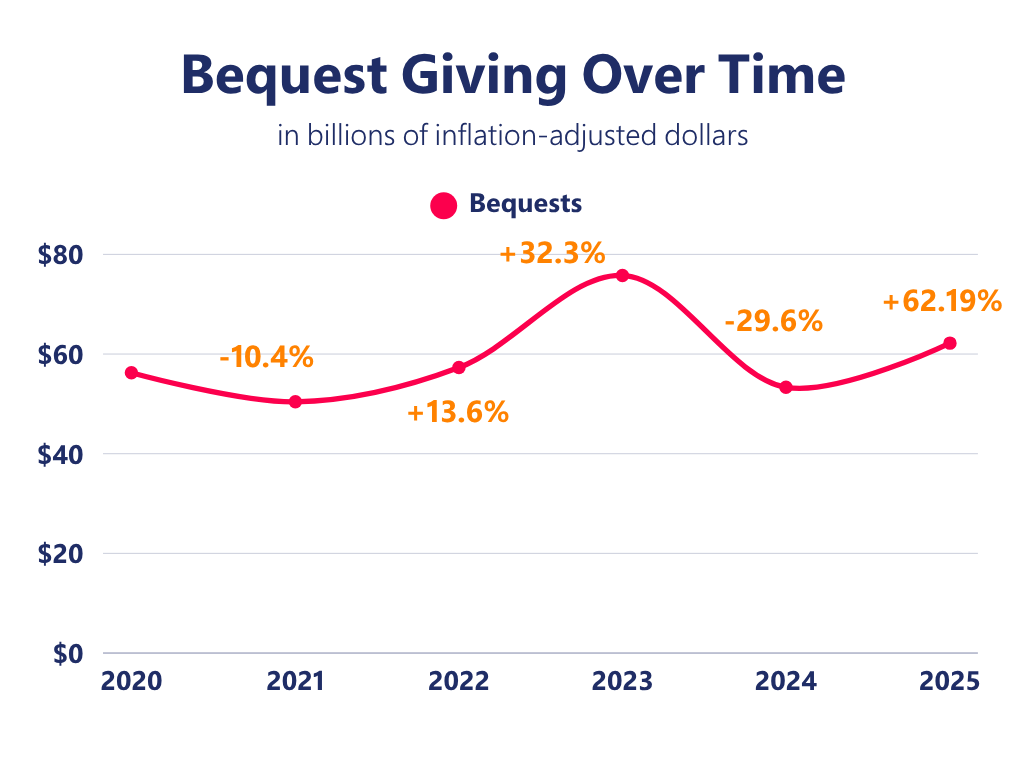
The percentage growth swings are pronounced even as the dollar values themselves are up and down on a gradual upward trajectory.
The exact timing of when these gifts will be realized contributes heavily to this fluctuation, but it previews what is to come with the upcoming intergenerational wealth transfer. An estimated $124 trillion will transfer between now and 2048, with some estimates noting a significant portion of those funds possibly being gifted to charities. This potential speaks to the continued need for nonprofits to invest in planned giving programs and to develop strategies to cultivate and steward gifts from donors with the capacity to make these gifts.
Navigating Philanthropic Volatility Through Disciplined Development Strategies
What does all of this data mean for development teams and nonprofit leaders?
It highlights that donors continue to give and that nonprofits who build meaningful relationships and engage donors in their missions face increased fundraising opportunities, though they do so in a marketplace that’s changing and continues to be shrouded in uncertainty. The strategies required to persist and to grow remain largely the same. They just require thoughtful planning, ensuring the right resources are deployed with a disciplined focus on execution.
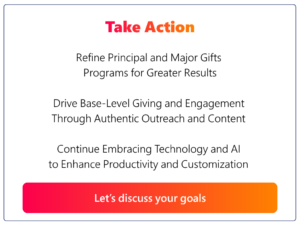
Refine Principal and Major Gifts Programs for Greater Results
Solicitations for significant gifts have always required careful consideration and planning. Advancement leaders and fundraisers must lean into this work through the adoption of both individual, donor-centric, and aggregate pipeline approaches that advance key gift cultivation strategies that balance donor and organizational timelines. Keeping gift officers and leaders on track and accountable to deepening relationships and driving gift conversations requires a well-run, measured individual giving program and approach.
Drive Base-Level Giving and Engagement Through Authentic Outreach and Content
The nonprofits bucking the national trend of declining donor counts are those with intentional engagement, annual giving, and donor engagement strategies rooted in authentic communication that builds relationships with donors at scale. Identifying how to connect donors with your mission and the impact of their giving more directly will help ensure current donors are retained and constituents convert to donors.
Continue Embracing Technology and AI to Enhance Productivity and Customization
In the years since generative AI entered the mainstream, what’s possible with the assistance of large language models (LLMs) through tools like OpenAI’s ChatGPT and Anthropic’s Claude has grown by leaps and bounds. Technology alone will not drive philanthropic connection between donors and nonprofit missions, but it can create opportunities for development staff to work more efficiently and better design processes and workflows to create and manage meaningful donor journeys and experiences. Customization is possible on larger scales. Automation of routine tasks and reminders is possible in ways that permit staff to set and execute strategies without constant revision and review. Thoughtful technology-enabled systems and processes will permit people to more effectively connect with donors, thereby creating new opportunities.
Sustaining Momentum Requires Eliminating and Overcoming Friction
Giving grew in 2025 even as it continued to change in the face of significant policy and economic headwinds. Growth like that didn’t just happen. It was the result of diligent work and earned wins from fundraising and nonprofit teams who found ways to create new opportunities and navigate obstacles—to eliminate and overcome friction—that could have otherwise stalled the momentum of giving’s continued growth.
The data tell us the recipe for fundraising success in 2026 remains the same. Embrace certainty and what your nonprofit can control. Find ways to optimize your efforts to meaningfully engage donors with your mission. Remind yourself often of the impact of your work and the power of inviting others to be partners in making the world better through your nonprofit and your mission.