
Healthcare organizations rely on strong fundraising results to advance care in their communities. In 2025, giving to health-related nonprofits reached an all-time high of $61.43 billion, a 3.3% over the previous year when adjusted for inflation. Plus, according to BWF Zuri’s 2025 Healthcare Survey, wealthy donors list giving to healthcare causes as their top philanthropic priority.
However, with threats like federal funding cuts, tax deduction changes, and rising costs for supplies and personnel, healthcare organizations must pivot their revenue strategies quickly to maintain fundraising momentum and growth. Grateful patient programs are one of the best ways to raise funds and drive donor engagement in the modern healthcare era.
Grateful patient programs provide an avenue for patients who have had an outstanding experience to show their appreciation. You may also find patients who have had a poor experience want to give a donation to improve the experience and outcomes for future patients. This guide reviews everything your organization should know about these programs, including:
- Defining Grateful Patient Programs
- Why Grateful Patient Fundraising Works
- Should Your Hospital Launch a Grateful Patient Program?
- How to Build a Successful Grateful Patient Program
- Grateful Patient Fundraising Examples
- How BWF Zuri Supports Grateful Patient Fundraising
First, let’s define grateful patient giving to help you understand whether this fundraising approach is right for your health organization.
Defining Grateful Patient Programs
What is a Grateful Patient Program?
Grateful patient programs are fundraising initiatives that involve cultivating relationships with patients who have had a positive, and sometimes a negative, experience with your healthcare organization or hospital. To help these patients express their gratitude or impact care for future patients, your organization provides opportunities for these individuals to give back and make a difference through donations.
Key Benefits of Implementing a Grateful Patient Program
Grateful patient fundraising offers unique benefits that can support your overall revenue goals:
- Enhanced donor pipeline — Grateful patients are strong donor prospects as they have a personal connection with your organization. As a result, your patient audience is one of the largest and most passionate sources of loyal donors.
- Increased engagement across care teams — Building up your grateful patient program can strengthen your fundraising team’s connection with care providers, leading to integrated fundraising across teams.
- Sustainable revenue for healthcare innovation — Grateful patient donors often provide recurring revenue, which gives your organization the foundation it needs to pursue healthcare innovations and improvements.
Core Components of a Grateful Patient Program
A grateful patient program should contain these essential elements:
- Identification: Search your healthcare database to identify patients who are strongly connected to your organization and have the financial ability to give.
- Cultivation: Build connections with prospective donors through consistent and genuine outreach via email, social media, phone calls, and in-person meetings.
- Solicitation: Engage prospects in a tailored philanthropy conversation based on their level of interest and giving capacity.
- Ongoing engagement: Thank donors, provide impact updates, and continue building relationships to increase the chances of ongoing support.
The Evolution of Grateful Patient Programs in Hospital Fundraising
Grateful patient programs have become more sophisticated over time. These programs started with basic outreach and manual patient identification, which involved staff members manually scanning constituent databases and compiling lists of prospective donors.
In the modern era, grateful patient programs have evolved to ensure HIPAA compliance, prioritize physician partnerships and participation, and leverage innovative AI tools to streamline prospect identification.
Why Grateful Patient Fundraising Works
Grateful patient fundraising works because it builds on moments of deep emotional connection. Patients who have had positive, and occasionally negative, life-altering care experiences are uniquely motivated to give back to the organizations that supported them through challenging times or can help advance care for future patients.
Research illustrates the effectiveness of grateful patient programs. A 2023 benchmark by Digital Health Strategies found that:
- ~90% of hospitals and healthcare systems with a digital grateful patient program say they see improved donor conversion and increased average gift sizes.
- 86% of respondents with digital grateful patient programs saw more new donors.
- 93% of respondents saw larger first gifts.
These findings demonstrate how grateful patient programs translate appreciation and mutual respect and/or desire to make a difference into measurable fundraising success.

Should Your Hospital Launch a Grateful Patient Program?
Why Some Hospitals Struggle with Grateful Patient Programs
While grateful patient programs are widely adopted, they are not successful at every institution. Some hospitals—especially smaller community-based facilities or those with resource constraints—opt out of these programs for reasons such as:
-
- Concerns about patient privacy and consent: Institutions may feel their patients would react negatively to using their data in fundraising efforts, seeing it as an infringement of their privacy.
- Lack of infrastructure: Effective grateful patient programs require strong data governance and coordination between development and clinical teams. This level of collaboration may require resources not all hospitals have, especially smaller ones.
- Cultural concerns: Some healthcare organizations, especially nonprofit and faith-based ones, may be concerned that a too-strong focus on patient fundraising can interfere with their missions to serve their communities.
Alternative strategies to grateful patient programs
Grateful patient fundraising is optional, and whether or not you participate is up to your organization. If you don’t want to go the grateful patient route, there are plenty of other ways to boost revenue through philanthropy. These include:
- Community-centric fundraising: This strategy involves cultivating long-term relationships with community members and organizations, such as local businesses, volunteers, and civic leaders, rather than patients.
- Institutional donor prioritization: With this strategy, organizations target foundations and board members as primary funding sources instead of patients.
- Grants and philanthropic collaborations: Many healthcare organizations partner with public health organizations or academic research institutions to secure donations.
Why Your Organization May Choose to Promote a Grateful Patient Program
If you’re on the fence about whether building up and widely promoting your grateful patient program is the right move for your healthcare institution, consult with multiple teams across your organization (from your fundraising squad to healthcare providers) and ask yourself the tough questions.
Use this checklist to help determine whether it’s the right time to start advertising your patient gratitude program:
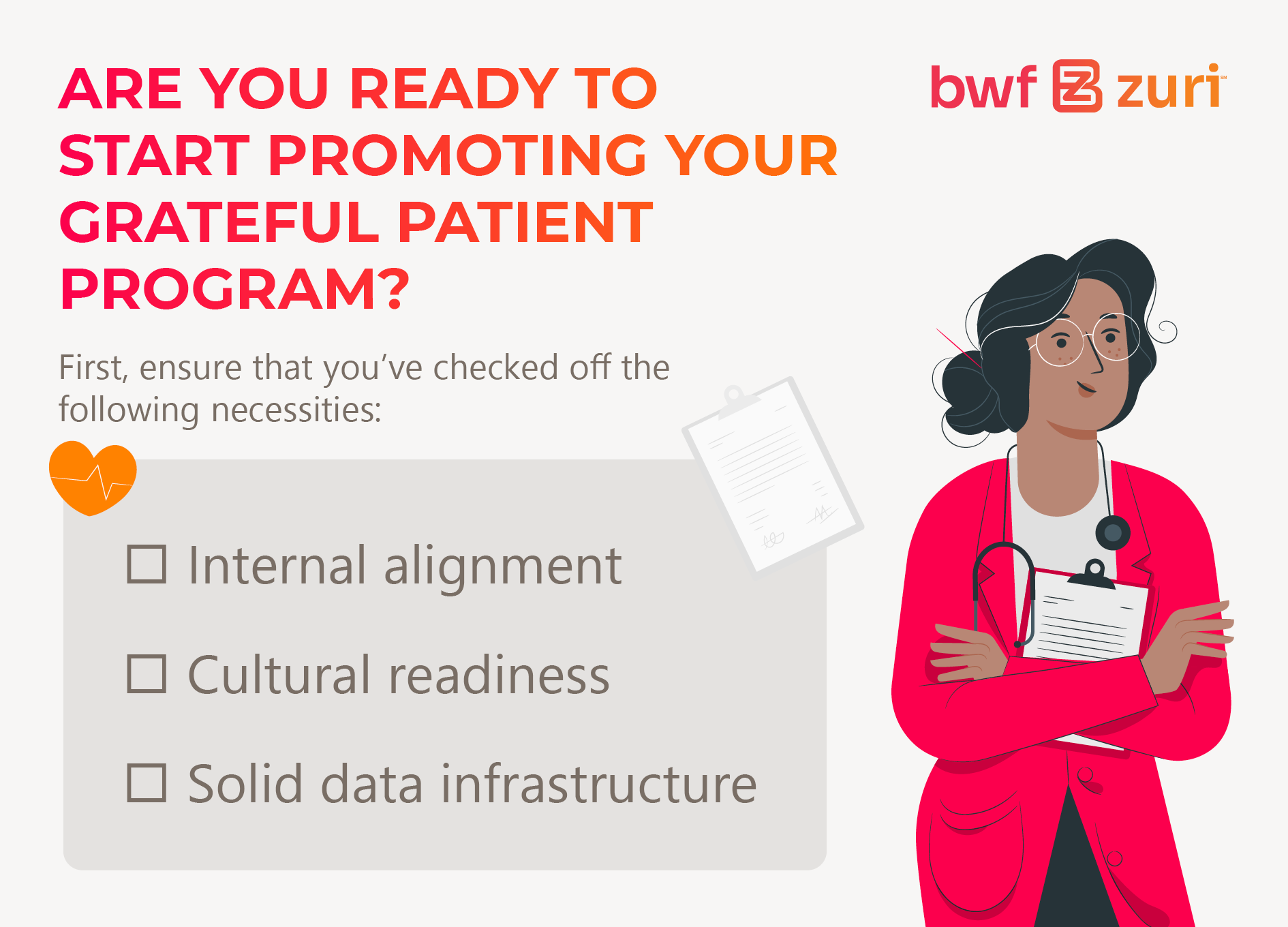
- Internal alignment: Have you navigated staff or leadership objections and ethical considerations and determined that grateful patient fundraising aligns with your mission?
- Cultural readiness: Did you gather feedback from a core group of community members and patient families and assess whether they would be receptive to this program?
- Solid data infrastructure: Do you have strong data governance policies to maintain legal compliance throughout the fundraising process?
If you answered “yes” to all of these questions, grateful patient fundraising might be right for your institution.
How to Build a Successful Grateful Patient Program
If you decide to move forward with a grateful patient program, follow these essential steps to build a strong foundation:
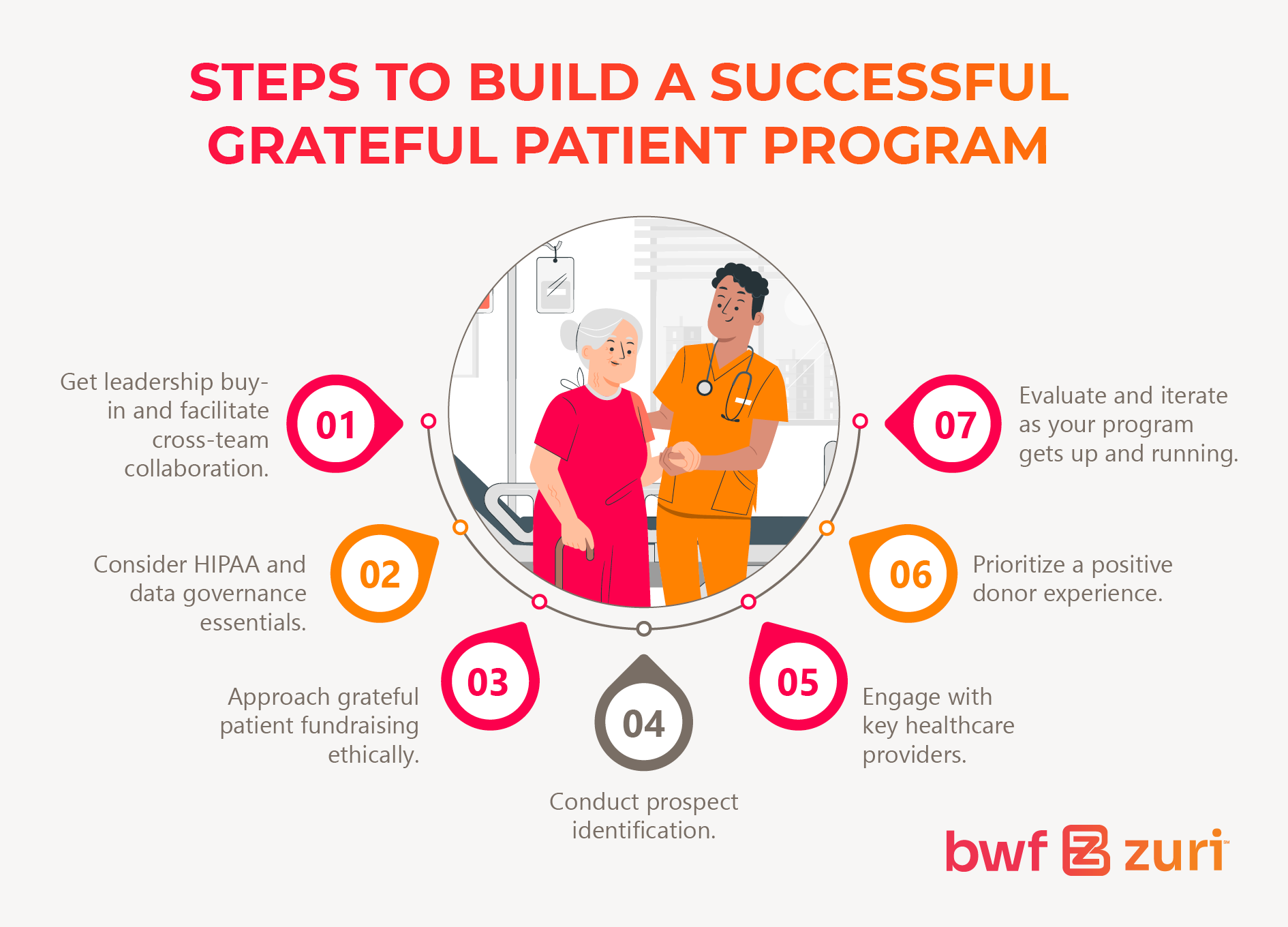
1. Get leadership buy-in and facilitate cross-team collaboration.
Building a grateful patient program is a significant undertaking that requires the support of your healthcare organization’s administrative leaders, clinical leaders, board members, and fundraising staff. Get the necessary buy-in and set your team up for success by keeping these best practices in mind:
- Ensure your board is on board with your new program. Present the concept of your grateful patient program to your board in a dedicated meeting. Walk through the core components of the program, along with its goals and benefits for your fundraising efforts. Additionally, provide details on the program’s expected ROI so leaders can understand how the fundraising revenue will offset the expenses needed to launch and maintain it. Address any questions or concerns to ensure complete understanding.
- Set up internal communication pathways. Create open lines of communication between the teams involved in grateful patient fundraising. This includes opening a dialogue between your fundraising team members (who are well-versed in donor cultivation and solicitation) and your care providers (who already have strong bonds with prospective patient donors).
Transparency is the name of the game when it comes to grateful patient fundraising. Whole team alignment from the beginning will make the start-up process much smoother and allow you to maximize grateful patient engagement.
2. Consider HIPAA and data governance essentials.
Work with your compliance team to set policies that comply with HIPAA and maintain data security and integrity. To do so, you should:
- Maintain the security of PHI by using constituent relationship management (CRM) platforms that encrypt sensitive data.
- Ask patients for consent before using diagnosis or treatment information in fundraising.
- Provide all patients with the option to opt out of using their PHI for fundraising at any time.
Require fundraising team members to complete regular data security training and assessments, so they understand the full scope of their data security responsibilities.
3. Approach grateful patient fundraising ethically.
In addition to maintaining HIPAA compliance, your organization should strive to create an ethical program that doesn’t sacrifice quality patient care for fundraising goals.
The Association for Healthcare Philanthropy offers clear ethical guidelines for grateful patient fundraising that all healthcare institutions should align with:
- For physicians: The physician’s role is first and foremost to provide outstanding medical care to all patients.
- Physicians should encourage patients who express interest in donating to connect with the hospital’s fundraising team members to discuss how they can become more connected with the hospital.
- Physicians should exercise extreme caution when considering whether to discuss fundraising with patients. They should only do so when they’ve determined that these conversations will not jeopardize the patient’s trust.
- For development directors: Development directors should form clear boundaries with patient donors at the beginning of the relationship, since these relationships can often span many years and become deeper over time.
- Development professionals should revisit these expectations regularly and continually clarify that their role is chiefly to facilitate philanthropic opportunities.
- For institutional leaders: Institutional leaders should thoughtfully consider how to avoid any real or perceived conflicts of interest regarding grateful patient giving.
- Leaders should think carefully about the perception of enhanced care for major donors. They should strive to provide the same level of care to all patients and ensure that any concierge services offered to grateful patients don’t negatively impact their ability to serve all patients.
Explore the complete list of guidelines and determine how you can incorporate these essential ethical safeguards into your grateful patient program. Share these guidelines transparently with internal and external stakeholders to avoid misunderstandings.
4. Conduct prospect identification.
The right prospects for your grateful patient program are individuals with the capacity and motivation to give back to your healthcare organization.
To ensure you’re focusing on the most valuable and promising giving candidates, BWF Zuri recommends a dynamic scoring approach to prospect identification:
- Scan your internal donor data for wealth indicators (like real estate or stock ownership) and warmth data (like a longstanding relationship with your hospital or a history of previous donations).
- Pinpoint current funding priorities (like research or equipment upgrades) to identify the donor groups most likely to support those initiatives (such as monthly donors, major donors, or capital campaign donors).
- Determine the unique characteristics that distinguish each core group of prospective donors, such as their average giving amount, donation frequency, or interest in specific campaigns or projects.
- Apply these scoring criteria to all constituents in your database using predictive modeling. You’ll receive a custom score that indicates each individual’s likelihood of becoming a grateful patient donor.
Implementing a prospect identification process can enhance program ROI by allowing you to dedicate your time and energy to nurturing prospects likely to donate and become loyal supporters.
5. Engage with key healthcare providers.
Collaboration between fundraising teams and care partners is essential to a smooth grateful patient fundraising experience. It all starts with building trust with clinicians and meeting them where they are to ensure they understand your program’s structure, goals, and ethical guidelines.
Forge trust with care providers by taking these steps:
- Address common healthcare provider concerns, such as clinician discomfort or inexperience with fundraising.
- Develop training modules to explain how your organization’s grateful patient program works and how it prioritizes HIPAA compliance.
- Provide physicians with resources and materials, such as talking points they can follow if a patient raises interest in grateful patient giving, or an informational sheet they can provide patients with that has all the information needed to become more involved with your hospital.
- Let doctors know ASAP when a patient has donated so they aren’t caught off guard if, and when, the patient mentions the gift.
- Ensure your fundraising team understands the basics and importance of the healthcare projects or programs they seek to help fund. Physicians will have more trust in your development team when it’s clear that fundraisers have done the necessary background research to understand care providers’ needs.
- Provide transparent fundraising updates on whether your program is doing well or facing challenges, as well as keep referring clinicians updated as to your ongoing discussions with their patient donors.
A physician’s role isn’t fundraising, just like a fundraiser’s role isn’t to provide expert patient care. However, fostering a basic sense of mutual understanding and shared commitment between these teams is necessary to ensure your hospital or healthcare system can serve its community now and in the future.
6. Prioritize a positive donor experience.
Like any fundraising initiative, your grateful patient program should be a positive, fulfilling, and meaningful donor experience. By emphasizing donor appreciation and engagement, you can build trust and loyalty with supporters, increasing the likelihood that they’ll give long-term.
Ensure donors enjoy being a part of your grateful patient community by following these tips:
- Address common donor concerns. Donors may have questions about how your organization protects their data, or whether you’re maintaining an equally positive healthcare experience for all patients (donors or not). Respond to donors’ concerns promptly and thoroughly to build trust.
- Express frequent and personalized appreciation. Send personalized gratitude messages, such as emails or handwritten greeting cards, to share your appreciation for donors. You can publicly spotlight donors using social media shoutouts or donor walls at your healthcare facilities.
- Provide impact updates. Share regular updates about how grateful patient gifts help your hospital achieve its mission to provide top-quality care to its community. For example, let donors know how their past generous contributions allowed your hospital to invest in updated X-ray technology for more accurate imaging and diagnoses.
Ask donors for feedback regularly through surveys, phone calls, and in-person meetings. Listen to their input and ideas for improving your program. Be sure to thank donors for their insights and follow up with them when you have a clear idea of how you’ll incorporate their feedback into your program.
7. Evaluate and iterate as your program gets up and running.
While presenting a clear and compelling fundraising opportunity to prospective donors is essential, your grateful patient strategy can be flexible. Track relevant metrics to assess its success and decide if you need to adjust your approach to better achieve your goals or meet donors’ needs.
Specifically, keep an eye on the following program metrics:
- Conversions: How many prospects become donors?
- Donor retention: How many grateful patient donors continue giving from one year to the next?
- Donor satisfaction: How satisfied are donors with the quality of your program?
- Giving amount increases: How has grateful patient engagement led to increased giving for each donor (measurements by aggregate dollars raised and increase percentage)?
As your program evolves, be cautious of operational pitfalls as well. Your team may have to work through challenges such as staff capacity, consistent donor follow-up, and health equity and ethics as you get your program up and running. To overcome these obstacles, stay communicative with your team and transparent with donors as you implement safeguards or change strategies.
Grateful Patient Fundraising Examples
As you determine the best way to structure your grateful patient program, it can be helpful to review other programs and get a sense for how other healthcare organizations approach this type of fundraising. While no two programs are identical, reviewing these examples allows your organization to identify strategies that might work for your unique goals and donor audience.
Spaulding Rehabilitation
Spaulding Rehabilitation provides multiple ways for patients, families, and other supporters to give back. The hospital offers four giving societies and facilitates donor-advised fund giving, monthly giving, employer matching gifts, tribute and memorial gifts, and more. Their website also includes a donor Honor Roll to recognize those who donate $1,000 or more.
Learn how BWF Zuri supported Spaulding with predictive modeling for more intentional fundraising
Children’s Healthcare of Atlanta
Children’s Healthcare of Atlanta offers a program for grateful families that want to “pay it forward” by sharing their stories, honoring caregivers, starting a fundraiser, or donating. Offering multiple ways to give back allows families to choose the option that best matches their values and philanthropic goals.
How BWF Zuri Supports Grateful Patient Fundraising
For over 40 years, BWF Zuri has been a trusted fundraising partner for various healthcare organizations, including children’s hospitals, academic medical centers, regional health systems, community hospitals, and other providers.
BWF Zuri helps healthcare organizations navigate funding and staffing challenges with an experienced, equity-focused consulting mindset. Many of our team members are former heads of development, and all of our consultants regularly attend professional healthcare conferences to stay updated on the latest developments in the world of healthcare fundraising.
We support healthcare fundraising with a wide range of services, including:
- Campaign assessments, planning, and counsel/management
- Philanthropy program performance assessments and growth strategy development
- Grateful patient program development
- Physician and leadership training
- Prospect identification
- Data governance best practices
- Major gift fundraising
We also offer extensive business intelligence services. For example, we helped the Phoenix Children’s Foundation develop a progressive technology roadmap and a sustainable business model to streamline reporting and speed up data retrieval.
In Conclusion
Above all, your patient-focused fundraising should be centered around compassion and relationship building. Patients feel motivated to give back because of the excellent experience they’ve already had with your healthcare organization. Build on that foundation by offering a grateful patient program that puts their needs first.
For more help building out a sustainable and effective healthcare fundraising program, check out these additional resources:
- Healthcare Fundraising: The 2025 Playbook for an Enhanced Experience. Build a holistic healthcare fundraising strategy with this comprehensive guide.
- The Annual Fund: Expert Guide to Inspiring More Support. Learn how to drive greater attention and donations to your organization’s annual fund.
- The Ultimate Guide to Driving Year-Round Donor Engagement. Inspire donors to stay involved by engaging them with these effective stewardship tips.
Let’s Talk
Meet with the BWF Zuri team to discuss your healthcare fundraising goals.