Giving to health organizations grew in 2024, reaching an all-time high of $60.51 billion. However, securing fundraising for medical research is often more nuanced than raising money for other healthcare funding initiatives. Research programs are complex, especially at academic medical centers, where patients receive care, and medical students, residents, and fellows get the training they need.
One of the top challenges for funding medical research is that donors may not know exactly what your program does or how specific research advances care and patient outcomes. You know that your medical research institute accelerates scientific breakthroughs and improves community health. But are potential donors aware of the impact of this research and how their gifts can support these efforts?
This guide will help development professionals at medical research centers structure their fundraisers to build lasting donor engagement. We’ll cover:
- Why Fundraising for Medical Research is Essential
- Top Fundraising Strategies for Medical Research Institutes
- Best Practices to Achieve Long-Term Medical Fundraising Success
- Work with BWF to Accelerate Fundraising for Medical Research
Let’s start by exploring why fundraising should be a top priority for your medical research organization.

Why Fundraising for Medical Research is Essential
The heart of your institution is the brilliant scientists, physicians, and researchers who achieve major medical breakthroughs. But your organization can’t afford to just keep its focus in the lab.
Fundraising should be a top priority to ensure your research center has the financial backing it needs to succeed long-term and continue supporting its community well into the future. Fundraising allows your medical research institute to:
- Drive innovation and scientific discovery.
- Fill critical funding gaps left by grants or government programs.
- Take risks on pioneering research.
- Enhance public trust and institutional reputation.
- Boost community health and well-being.
- Improve patient outcomes by curing diseases or developing new treatments
Amid federal cuts to healthcare research programs, it’s clear that medical research and healthcare institutions can’t rely entirely on government funding alone to succeed. Fundraising gives your organization breathing room—if one funding source dries up, you can depend on others to stay afloat.
Top Fundraising Strategies for Medical Research Institutes
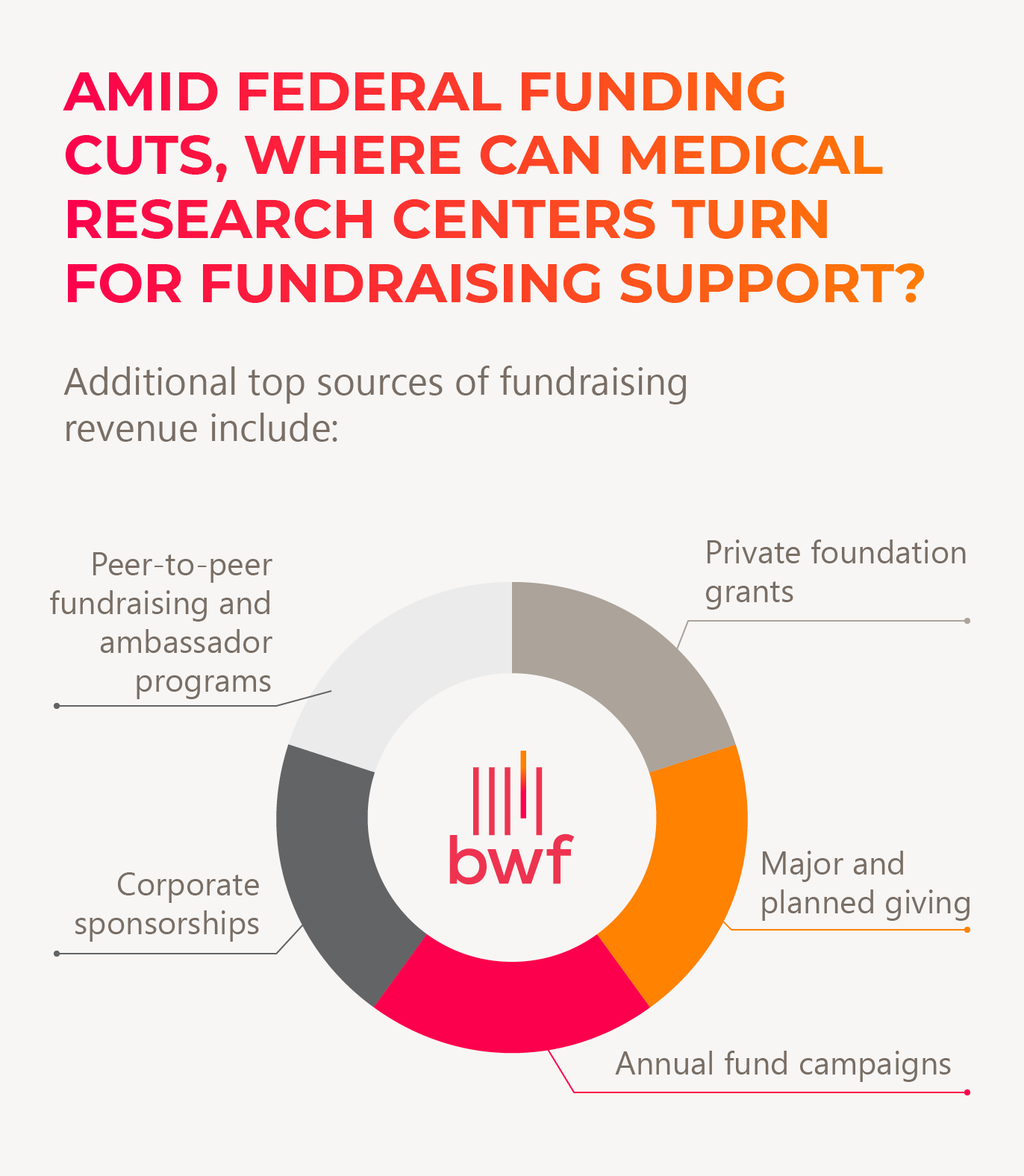
In the wake of disruptions to government funding, what additional revenue sources should your medical institution turn to for financial support? These fundraising avenues tend to have the strongest ROI for healthcare organizations:
1. Foundation grants
Many foundations are created solely to fund medical research. Examples include the Michael J. Fox Foundation for Parkinson’s research and the Novo Nordisk Foundation. Grants from these organizations are often worth millions of dollars, providing significant, multi-year support for your research goals.
Additionally, foundation giving tends to be more consistent than other funding streams. One study found that around “70% of the scientific and health research grants that foundations made one year were provided again the next year.” Achieving a high-value research grant can also boost your institution’s credibility, bringing greater attention to your research.
Your institution will have more fundraising success when you find foundations that are aligned with your research goals and tailor your proposals to their specific funding interests.
2. Major and planned giving
Major and planned giving donors give large monetary donations to your research program for various reasons. These often include being personally impacted or having a loved one affected by the medical issue on which your center focuses. For example, a donor who survived breast cancer may feel inspired to give to your cancer research institute.
These donors are essential to fundraising success, even though they make up a small percentage of total individual donors. The Pareto principle, or the 80/20 rule, is often referenced in relation to major donors; it suggests that a small percentage of donors (20%) contribute a large portion of donations (80%).
Identify and engage with these donors using these three steps:
- Prospect development: Use wealth indicators, philanthropic identifiers, and level of affinity for your cause to identify potential major and planned donors.
- Donor prioritization: Organize prospects based on their likelihood of giving so fundraisers know who to prioritize in their outreach.
- Relationship management: Fundraisers build and nurture relationships with prospects to inspire giving and loyalty.
Major and planned giving donors are essential for any fundraising campaign, whether you’re undertaking a comprehensive or capital campaign or building up your annual fund. Their support can help you get to the fundraising finish line and even exceed your goals.
3. Annual giving/annual fund campaigns
Your organization’s annual fund is the pool you draw from to cover ongoing, operational costs required to keep your research programs and projects running. Building up your annual fund is essential, as gifts to this fund are unrestricted, meaning you can use the funds without any limitations imposed by donors.
Annual gifts can help your research program fund any need, such as:
- Supporting risky early-stage research projects
- Sustaining funding during gaps in grant cycles
- Upgrading or refurbishing essential equipment
- Supporting clinical trials
- Covering day-to-day administrative costs like lab compliance or data storage
Major donors play a key role in annual fundraising, but you shouldn’t overlook mid-level donors. A study of mid-level donors found that these individuals are incredibly loyal, with over half supporting organizations for over a decade. These supporters are also valuable planned giving prospects. According to that same resource, 31% have made a bequest to a charitable organization, and another 23% say they plan to create one later.
4. Corporate sponsorships
Corporations are often highly motivated to partner with medical research organizations that align with their research and development goals. For example, Pfizer frequently partners with external academic research programs to further shared scientific goals in areas such as internal medicine and rare diseases.
In these scenarios, both the medical research organizations and corporations benefit:
- Medical research centers can access the resources and equipment they need to pursue experiments and answer essential questions.
- Corporations receive immediate access to emerging technologies, the latest therapies or diagnostics, and other innovations.
Corporate funding has become crucial amid federal funding cuts, with institutions like Harvard seeking support from biotech and pharmaceutical companies.
5. Peer-to-peer fundraising and ambassador programs
Remember the Ice Bucket Challenge? Even though that viral trend was an international sensation over a decade ago, its impact is still felt today in ALS research. Donations that poured in during this phenomenon helped fund breakthrough ALS research, allowing scientists to identify a common gene that contributes to the disease.
The success of the Ice Bucket Challenge and similar social media initiatives can be attributed to peer-to-peer fundraising. During these campaigns, supporters take on the role of fundraisers by creating personalized donation pages to raise money for your organization. They reach out to family and friends through social media, email, and other communication channels to share information about your mission and motivate their networks to contribute to your research.
Ambassador programs play a similar role; your organization can recruit and train volunteers to speak to the public about the importance of your research. These individuals act as liaisons between your research program and potential individual donors or corporate sponsors.
Both peer-to-peer fundraising and ambassador programs thrive because of social proof. When people see others like them—friends, colleagues, or family members—taking action for a cause, it creates a sense of belonging and momentum. It signals, “People like us support this. People like us get involved.” That common identity and purpose motivate individuals to not only give but also lead, advocate, and engage others on your behalf.
You can use these fundraising strategies to build genuine relationships with supporters based on increasing interest and dedication over time. Here’s an example of a donor journey that starts with peer-to-peer fundraising and ends with major support:
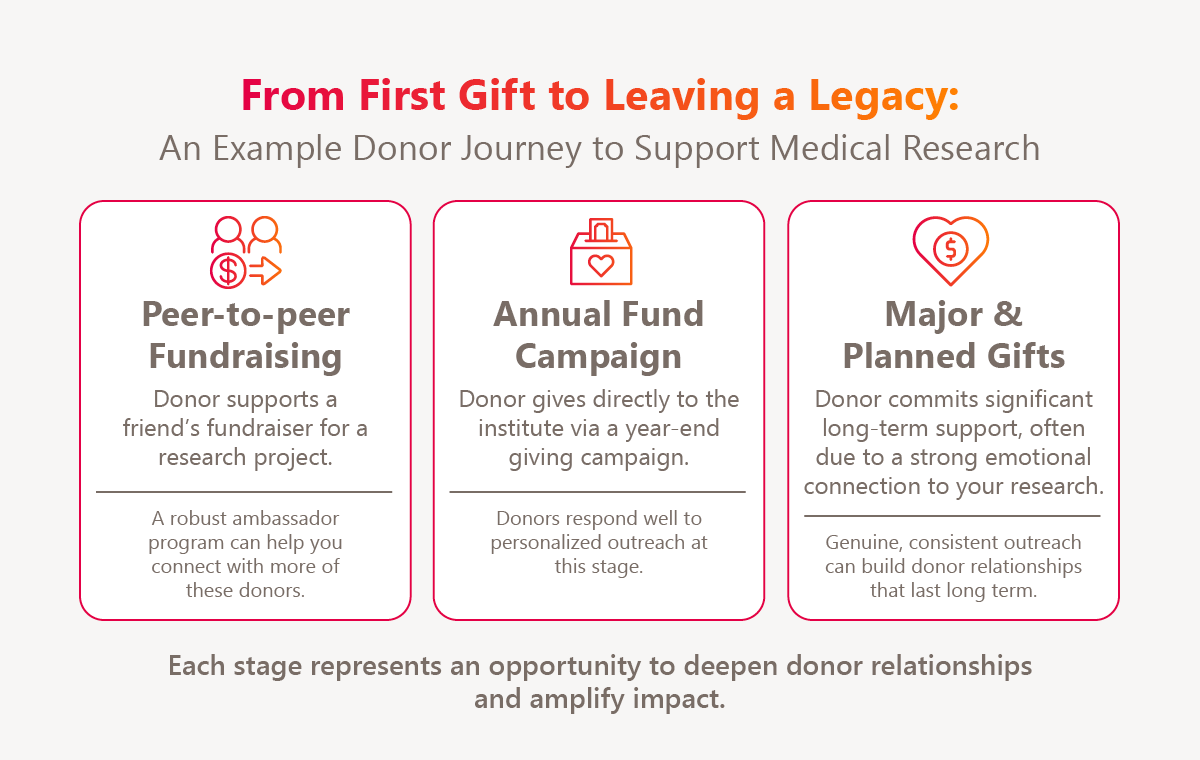
You can enhance supporter relationships at every stage of the donor journey through intentional cultivation and stewardship efforts. As a result, you can inspire new supporters to elevate their commitment from casual donors to loyal contributors.
Best Practices to Achieve Long-Term Medical Fundraising Success
Optimizing your research institution’s fundraising workflow takes patience and time, as well as trial and error. To help you get started, let’s explore a few tips, resources, and tools that can empower you to develop a fundraising program that’s made to last.
Understand why donors give
When you know why donors are inspired to give to your organization, you can tailor your fundraising strategies to encourage them to give again in larger amounts.
Understanding your organization’s donor pool comes down to answering two key questions:
- Who are your donors? Typically, people who give to medical research organizations include patients and their families, former physicians/students/researchers, research-focused funders (foundations, corporations), and other community members/leaders (civic leaders, corporate CEOs, etc.). Use prospect research and development to understand your donors’ distinctive traits.
- What do your donors want? Understanding the motivations, needs, and interests of your unique donor pool requires strategic analysis. Leverage donor sentiment surveys, predictive modeling, and behavioral segmentation to learn more about how your donors feel about your organization, how they currently engage with your fundraising efforts, and whether and how they plan to support you in the future.
After answering these questions, you can start to think about the how. How will your organization meet donors where they are to provide fundraising opportunities aligned with their interests? Would a peer-to-peer fundraising campaign or a gala fundraising event spark their attention? Do they gravitate toward data-driven impact reports or emotion-driven testimonials from people who your research has helped?
Use your donor data to build a tailored fundraising strategy based on your audience’s unique needs.
Collaborate with researchers to strengthen your case for support
Incorporating medical professionals into the fundraising process is essential for creating a robust case for support. These experts have invaluable experience and information they can pull from to help you outline what your institution does and how it positively impacts people in need of medical care.
Media outlets often also interview physicians and researchers to get sound bites and quotes about their research. It’s essential that these individuals feel comfortable talking about not only their own research in clear language but also how fundraising impacts their ability to achieve crucial goals.
Use these tips to build strong relationships with your research team:
- Host media training sessions. Help researchers package their findings into easily understandable sound bites they can use in newspaper or podcast interviews.
- Conduct active communication about fundraising initiatives or events in which researchers may be involved. For example, let’s say you want to launch a social media campaign with videos of researchers talking about their studies. Send calendar invites with all the information they need about their involvement in the campaign, such as when and where you will meet with them to record their video and how long you’d like them to talk.
- Provide transparency. Keep researchers informed about your fundraising progress, whether you succeed or face challenges.
Relationships between your research and fundraising teams should be built on trust, transparency, and mutual understanding. This foundation will empower your fundraising efforts and enable seamless cross-team collaboration.
Invest in quality fundraising tools
Fundraising software solutions allow your organization to keep its campaigns, events, and donor outreach organized and efficient. You can find fundraising tools for basically any need—events, auctions, email campaigns, text-to-donate, and more. However, the platforms that offer the greatest benefits for medical research institutions are:
- Constituent relationship management platform (CRM): Stores donor information (donation history, demographics, contact information, etc.) to help you build on past donor interactions and segment supporters for streamlined communication.
- Donor analytics tools: Evaluate your donor database to identify common giving patterns and trends and build on fundraising momentum through data-driven strategies.
- Wealth screening platform: Scans your donor database to identify wealth indicators like real estate holdings, stock ownership, and a history of large donations to other organizations.
- Prospect research solution: Takes wealth screening a step further by also scanning for warmth or affinity indicators (such as having a loved one who lives with the disease that your team researches).
- Marketing platform: Enables your organization to reach out to donors with personalized messages that leverage information in your CRM. You can also use these tools to automate communications. For instance, you can send automated emails each time you update your website’s blog.
Some fundraising solutions are unified or all-in-one platforms, which offer multiple functions (fundraising, donor management, event management, etc.) within one platform. Other solutions specialize in specific aspects of fundraising and leverage integrations with other tools to offer more robust functionality.
Consider whether your fundraising efforts would benefit more from the comprehensive functionality of a unified platform or the targeted support of a specialized tool.
Leverage AI for streamlined donor outreach
AI solutions are another essential tool for your fundraising toolkit. These platforms help automate the fundraising process by evaluating your donor data and recommending specific next actions your organization should take to better engage its audience.
Additionally, predictive AI can identify which fundraising efforts are most likely to succeed, helping you focus your resources to earn a better return on investment (ROI). Predictive modeling involves the following steps:
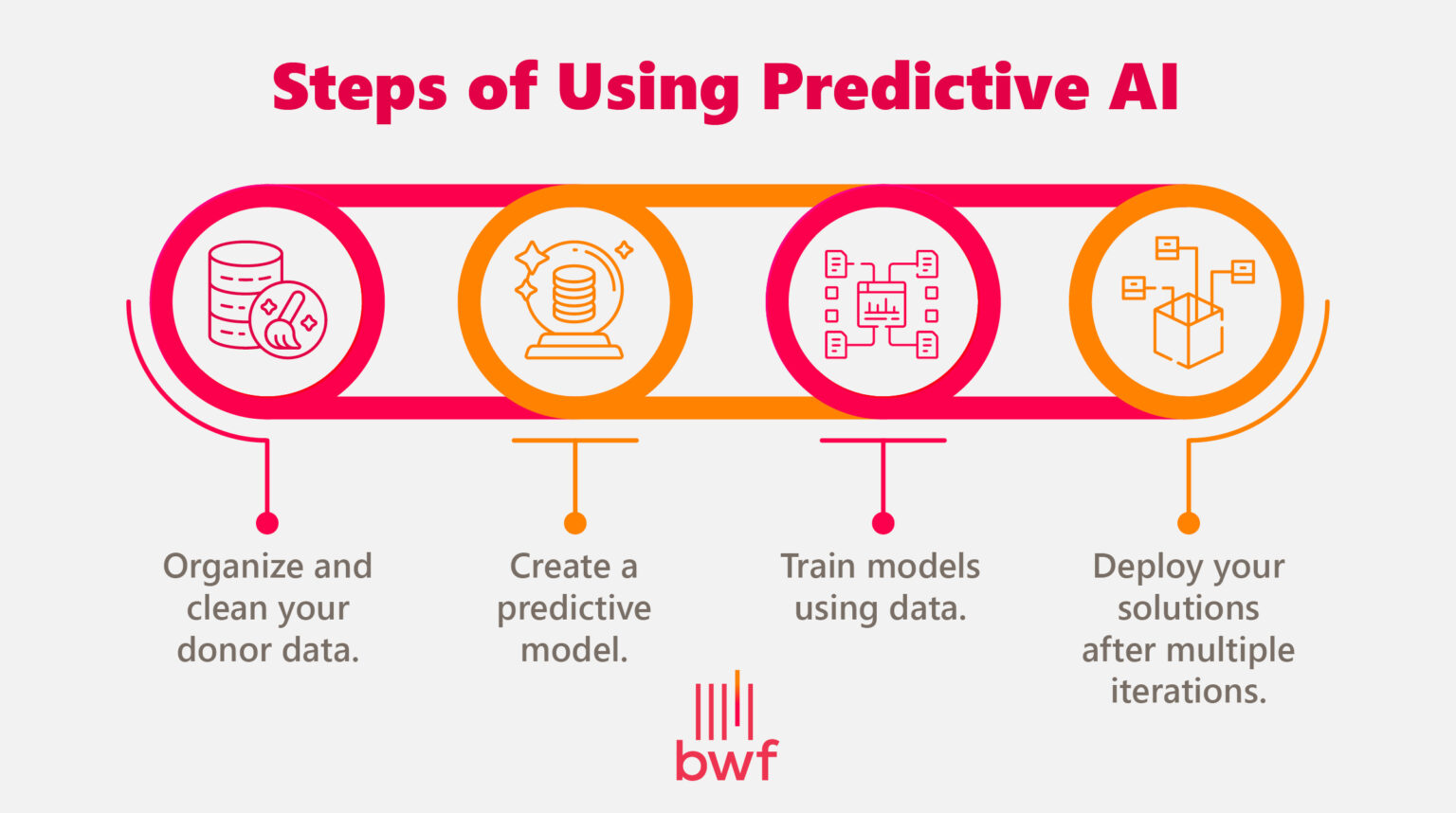
- Ensure your donor data is organized and clean.
- Develop your predictive model by partnering with a data analytics expert like BWF.
- Train the model by feeding it your donor data and assessing the validity of its outputs.
- Deploy your solution when you’re satisfied with its performance.
You can develop predictive models for just about any aspect of fundraising, including donor segmentation, prospect identification, campaign performance prediction, and donor journey mapping.
Let’s take a look at an example of this in action. Say your fundraising team wants to determine which donors are likely to give to your new research project to help pinpoint the causes of mental illnesses like OCD and anxiety in young adults. The modeling process could look like this:
- Predictive solution: Your institution conducts a predictive analysis using donation, demographic, and philanthropy interest data.
- Scoring: You score prospective donors based on their likelihood of supporting your OCD and anxiety-focused research.
- Prioritization: Your fundraising team creates a list of 50 high-affinity, high-wealth prospects, several of whom have personally dealt with OCD and anxiety.
- Cultivation: You initiate targeted outreach to top prospects with personalized emails and informational materials that explain your research goals.
- Likely outcome: Your outreach campaign surpasses your expectations, resulting in a higher ROI for your fundraising efforts because you avoided time wasted on cold outreach or misaligned prospects.
Use visuals and data to demonstrate impact
Visuals capture supporters’ attention and bring your research to life. In fact, content with visuals is 40x more likely to get shared on social media than posts with just text.
Data can play a similar role in your audience engagement efforts, especially when you include it in a well-written, compelling story. Marketers have found that stories are 22 times more memorable than facts alone.
Enrich your fundraising outreach with visuals and data stories such as:
- Charts, graphs, or maps showing your impact
- Patient testimonials with photos and direct quotes
- Videos showcasing researchers sharing their findings
- Detailed annual reports that combine data with compelling testimonials
Use A/B testing to evaluate the effectiveness of your visual and data storytelling efforts. For example, you could send two versions of the same email—one with an infographic summarizing research milestones and another with a photo of a lead researcher—to similar audiences. Track which email receives the highest engagement via opens and clickthroughs to your website.
By keeping the caption and timing the same, you can compare which version drives more engagement (likes, shares, views), helping you determine what type of visual content resonates most with your audience.
Maintain consistent and transparent donor communications
To support your research efforts over the long term, it’s critically important that your organization doesn’t just focus on new donor acquisition but also donor retention. According to data from the Fundraising Effectiveness Project 2024 report:
- New donor retention dropped by 5.9% year-over-year, with only about 19% of donors in 2023 giving again in 2024.
- Repeat donor retention declined by 3% relative to 2023, but at 69.2% year-to-date, it remains much higher than retention rates for new donors.
This data highlights how essential it is to secure second gifts from donors. The key to increasing donor engagement and boosting retention? Clear and consistent donor communications.
Keep donors in the loop regarding research progress and the impact of your studies. Use the following platforms to send donors research updates, thank them for their support, and outline the impact of their gifts on real people in need:
- Email newsletters or appreciation messages
- Phone calls to thank donors for recent gifts
- Direct mail newsletters or booklets with recent research findings
- Social media shoutouts or behind-the-scenes looks at how your organization operates
Build trust with donors by sharing both your successes and setbacks. For example, if a study disproves your initial hypothesis, explain how that “negative” result is still a critical step forward because it will help researchers refocus on more promising areas of study. Transparency like this reinforces your credibility and shows donors that their support fuels real scientific progress.
With this level of openness and engagement, you can build donor relationships based on trust and positive impact, rather than transactions.
Diversify your fundraising efforts to build resilience
Pursuing multiple fundraising avenues allows your research organization to stay resilient amid funding disruptions and challenges. If one fundraising source starts to dip, you can rely on a range of other initiatives to keep your projects and programs running.
Diversify your fundraising strategy by incorporating:
- Multiple campaign types – events, peer-to-peer fundraisers, email campaigns, etc.
- Multi-level donor outreach – major, mid-level, and small donors.
- Multiple fundraising sources – grants, individual giving, corporate giving, etc.
Remember that the quality of your fundraising efforts is just as necessary as the quantity. If one area of your fundraising strategy hasn’t historically received much attention, make sure your fundraising team spends time and resources making it an appealing option for potential donors.
Think locally
Sometimes your greatest fundraising champions are just a block away. According to a health philanthropy study of foundation grants supporting scientific research, almost “40% of those grants and 60% of the total number of dollars given backed scientific and health research initiatives based in the donor’s or the foundation’s own state.”
By engaging with local media and news outlets, you can share your research progress and demonstrate how your studies will positively impact your community. Create branded press releases and send them to local media outlets such as:
- Newspapers
- Magazines
- Radio Stations
- TV stations
- Podcasts
- Bloggers
Media coverage will help generate awareness of your institution’s philanthropic goals and promote fundraising opportunities for community members to get involved.
Maintain ethical compliance
When fundraising for medical research, your organization must adhere to a few legal guidelines, among the most important being HIPAA. HIPAA was created to ensure that “individuals’ health information is properly protected while allowing the flow of health information needed to provide and promote high quality health care… The Rule strikes a balance that permits important uses of information, while protecting the privacy of people who seek care and healing.”
Keep HIPAA compliance and other ethical considerations top of mind by following these tips:
- Share patient journeys responsibly. Get written, voluntary consent from patients to share their stories and any protected health information (PHI) such as their names and specific diagnoses.
- Ensure your legal and institutional review board (IRB) oversees any fundraising messages containing information about human research subjects. This will help ensure legal compliance.
- Tell patient stories thoughtfully and respectfully. Don’t sensationalize medical issues or reduce patients to victims. Instead, tell stories of strength, hope, and resilience. Also, be careful not to overpromise or mislead your audience by making guarantees about your research. Use balanced framing to ensure your content is realistic.
You should always run your medical research fundraising plans by your organization’s legal team to avoid risks. This is the number one way you can protect your organization from liability and ensure your fundraising efforts are ethical.
Work with BWF to Accelerate Fundraising for Medical Research
Fundraising demands on medical research institutes and healthcare organizations have never been higher. With rising competition for grants, declining federal support, and increasing pressure from leadership, today’s fundraisers must navigate a complex and high-stakes environment.
No one understands that better than the experienced fundraisers at BWF. Our consultants are well-versed in both the current challenges and opportunities present in the healthcare fundraising space. Many of our team members are former healthcare development leaders, so they intimately understand the current landscape and strategies your organization can use to maximize giving.
Our health fundraising services are built to meet the moment. We can support your organization with:
- Grateful patient program optimization
- Fundraising campaign management
- Major gifts strategizing and program implementation
- CRM implementation
- Data science and prospect research
We partner with medical research institutions to assess current fundraising performance, identify opportunities, and deliver integrated strategic, technical, and operational support to maximize giving. Don’t just take our word for it—see how our healthcare fundraising support helps clients optimize their data to reach ambitious goals.
Wrapping Up
Now is the time for your medical research organization to dive headfirst into optimizing its fundraising program. With the strategies and tips in this guide, you can build a program that serves your organization, now and in the future.
Explore these additional resources to help build your fundraising program’s resiliency:
- Healthcare Fundraising: The 2025 Playbook for an Enhanced Experience. Build a well-rounded healthcare fundraising strategy with the help of our complete guide to modern healthcare fundraising.
- Prospect Development: Tips to Build a Smarter Donor Pipeline. Design a sustainable donor pipeline with our tips for identifying and cultivating the right donors.
- Why Predictive AI in Fundraising Works Best with Human + Machine Collaboration. Strike a balance between automation and personalization with our best practices for human and machine collaboration in AI fundraising.
And if you’re looking for a dedicated, experienced, and trustworthy fundraising partner, contact the BWF team below.
Let’s Talk
Find out how BWF can support your medical research fundraising strategies and goals.