
Artificial intelligence is becoming the seatbelt of philanthropy—not glamorous but irresponsible to ignore.
Prospect screening tools, donor scoring, and predictive models are now widely available and increasingly similar. As a result, many nonprofit leaders are asking a more nuanced question: If everyone has access to AI, where does competitive advantage actually come from?
The answer is not more data. It is more focused intelligence.
In fundraising, bespoke AI models built exclusively on an organization’s own data, donors, and strategic priorities will consistently outperform collective, generalized AI models. Not because collective models are wrong, but because fundraising itself is not generic.
The Limits of Collective AI
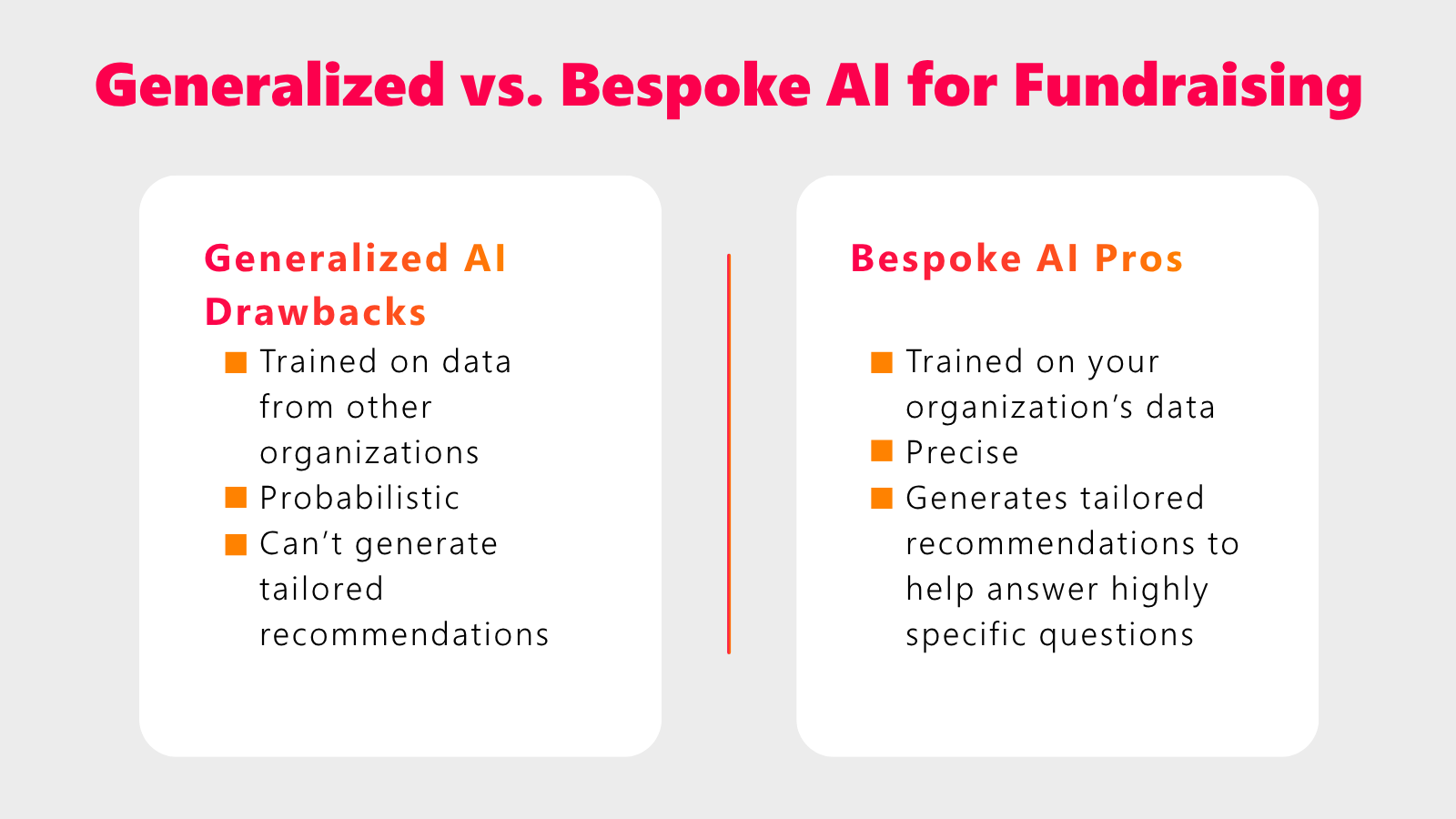
Most philanthropic AI platforms rely on common or broadly aggregated data. They identify patterns across large populations: donors who tend to give to healthcare, education, or human services; individuals with capacity; and constituents whose past behavior resembles that of other donors.
This approach is efficient. It is also inherently probabilistic.
Collective AI is well-suited to questions like:
- Who might be a good prospect for healthcare giving?
- Which donors resemble others who have supported similar causes?
- Where should we generally focus prospecting resources?
These insights are helpful, particularly for early-stage programs or broad segmentation. But they fall short when the question shifts from who is generally philanthropic to who will fund this specific priority.
And that distinction matters.
Fundraising is not Averages. It’s Decisions.
Fundraising leaders and prospect researchers are rarely asked to deliver averages. They are asked to make decisions. Consider the difference between these two questions:
- Which donors tend to give to heart-related causes?
- Who is most likely to fund our heart lab?
The first can be answered with collective data overlays: past giving, behavioral trends, capacity indicators, and affinity markers. The second requires a much more sophisticated approach.
It requires understanding how your donors behave in your ecosystem, how they respond to specific initiatives, and how timing, engagement, relationships, and institutional context intersect. That level of insight cannot be fully captured by generalized AI models trained on everyone else’s data.
Why Bespoke AI Goes Further
Bespoke AI models are trained on a single organization’s history, strategy, program performance, mission priorities, and donor behavior. They do not start with national philanthropic averages or shared screening assumptions. They start with what has actually happened inside your institution.
This change in approach with a closer lens enables a fundamentally different type of intelligence:
- Models learn which signals truly matter for you, not in theory.
- Predictions reflect donor trajectories over time, not static snapshots.
- Recommendations align to institutional priorities, not generic categories.
Instead of producing broad donor groups, bespoke AI can answer highly specific operational questions:
- Who is likely to fund this initiative, at this scale, in this window?
- Which prospects are aligned to transformational opportunities versus incremental giving?
- Where should frontline fundraisers focus right now—not eventually?
This is not about replacing human judgment. It is about sharpening it.
Precision Beats Overlay
Traditional screening and collective AI rely heavily on overlays, which stack capacity, affinity, and behavioral indicators to identify likely prospects. Bespoke AI moves beyond overlays to deep learning, recognizing nonlinear, contextual patterns that are often invisible to human analysis.
Two donors may look identical on paper—similar wealth, similar giving histories, similar demographics—but behave very differently when presented with a specific opportunity. Bespoke models learn those differences because they are trained to detect them within a single institutional environment.
The result is not only better prediction but also greater confidence in the subsequent decisions.
What This Means for Your Team
Instead of spending time validating generalized scores or reconciling multiple screening tools, researchers can focus on interpretation, strategy, next steps, and partnership with frontline fundraisers. The technology does the heavy analytical lift, surfacing insights that are immediately relevant to the organization’s goals. This makes your teams more efficient in their processes and more certain in their strategic direction.
In practice, this means:
- Fewer lists, more answers.
- Less guesswork, more justification.
- Better alignment among research, strategy, and action.
- Integrated decision intelligence, not isolated data.
- More confident portfolio decisions.
When intelligence is explicitly built for an institution, it becomes easier to trust and easier to use.
The Strategic Implication
Collective AI will continue to have a role in philanthropy. It democratizes access to data and lowers barriers to entry. But it also creates a ceiling: When everyone uses the same models trained on the same assumptions, differentiation disappears.
Bespoke AI breaks through that ceiling.
In a sector where missions are unique, donors are personal, and success depends on precision, the future belongs to intelligence that is purpose-built, not averaged out.
The organizations that unlock this opportunity will be the ones who turn their data into insight no one else can replicate.